Custom Rubber Manufacturing
Home >
Products >
Custom Rubber
Manufacturing
Minor Rubber has been providing Custom Molded, Extruded, and
Fabricated solutions for more than 70 years to the Electronics,
Transportation, Defense (DOD), Medical, Agriculture,
Aircraft/Aerospace industries, as well as many others. Our
experience in molding and extruding help us meet the most
demanding requirements of our customers. Whether your
requirements for custom rubber products are large or small,
complex or simple, our team can assist in finding a solution
that satisfies your needs. Our facilities are located in the
United States and Asia, allowing us to offer you versatility in
providing solutions that are cost effective as well as of
superior quality. From prototyping, to small or large volume
production needs, Minor Rubber offers a one-stop solution to all
of your rubber requirements.
Molding
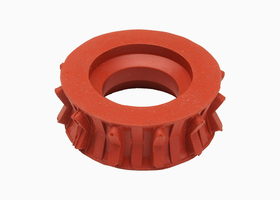
Minor Rubber produces custom molded parts from a variety of
different materials, hardness’s, and colors to suit a customer’s
specific application. In addition to our commercial grade
materials, we specialize in compounds that meet or exceed the
requirements of Military (MILSPEC), ASTM, SAE, ANSI, and FDA
specifications. When necessary, we are able to develop a
compound that is geared towards a customer’s specific
application. To see a list of available compounds please go to
our resource page.
Minor’s capabilities in the area of molding include compression,
transfer, and injection. Each of these methods has advantages
and disadvantages over the others. Below you will find a brief
overview of each of these methods.
Compression Molding:
Compression molding is the most fundamental method for molding,
its origins date back as early as the 1820’s. It is implemented
by placing a piece of uncured rubber, of a predetermined weight
and size, into the cavities of an open mold. The mold is then
closed, as far as possible, and placed into a hydraulic molding
press. Pressure from the press causes the uncured rubber to form
into the shape of each cavity, and heat from the platens of the
press causes a chemical reaction, known as cross linking,
causing the rubber in the cavity to “cure”.
Our molding press capabilities for our compression line range
from 12” x 12” on the low end, up to and including 85” x 108” on
the high end, with various press sizes in between.
Advantages of compression molding
- Inexpensive tooling
- Less compound waste
- Good choice for large parts
- Good for low production quantities
- Good for high durometer parts
Disadvantages of Compression molding
- Longer loading and process time
- Labor intensive finishing
- Heavier flash resulting in possible quality / tolerance
issues
Transfer Molding:
Transfer molding is an extension of compression molding, but
utilizing methods similar to injection molding. It is
utilized in applications involving higher production
quantities than would be normal for compression molding. The
major difference between compression and transfer is that
the uncured rubber is placed in a “pot / ram” combination
built into the top of the mold, and utilizing the closure of
the molding press to force the uncured rubber through small
holes (sprues) into the cavity(s). The balance of the
process is the same as is found in compression molding.
Our molding press capabilities for transfer molding are the
same as for the compression line. Please see compression
molding above for press capabilities.
Advantages of Transfer molding
- Shorter production cycle then the compression method
- Compound preparation and tool loading time is reduced;
individual cavities do not have to be loaded with uncured rubber
- Product finishing time is reduced. Since the mold is closed
before introduction of the uncured rubber, the part when removed
from the mold will exhibit less flash
- Transfer molds can be run in a conventional compression
type molding press; no special equipment necessary.
Disadvantages of Transfer molding
- Tooling is more expensive than a compression mold
- More material waste due to excess left in the “pot” and the
runner system.
Injection Molding:
Injection molding is accomplished in a molding
press specifically designed for that purpose. The mold is
closed and locked into place by the operation of the press
itself. Uncured rubber is pre-heated in an injection chamber
prior to being injected into the mold itself, which
“plasticizes” it allowing it to flow more readily through
the injection system and into the cavities. This, along with
the clamping and injection force provided by the press,
allows curing temperatures to be elevated, shortening the
curing cycle. Our injection press capabilities range from
24” x 24” up to 48” x 72”, with tonnage (clamping force) of
100 to 500 tons. The clamping force of an injection press is
what keeps the mold tightly closed during the injection and
molding cycle.
Advantages of Injection molding
- Shorter production cycle than the other two methods due to
higher clamping/injection pressure and curing temperature
- Higher production rate per hour than other methods results
in lower unit cost
- High clamping pressure on mold results in parts having very little or no
flash compared to other methods
- Parts may not need any additional finishing processes
Disadvantages of Injection molding
- Requires large production runs to be efficient.
- Tooling cost considerably higher than other methods
- Not all compounds, or durometers, are suitable for this
process
Extruding:
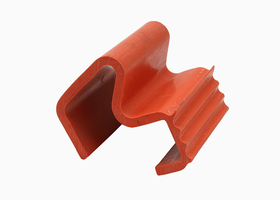
Our 90,000 sq ft extruding facility located in the U.S.A. is
capable of producing custom profiles, tubing, cut washers
and gaskets, as well as vulcanized spliced gaskets, gaskets
with injection molded corners and seals in an infinite
variety of shapes and sizes. Extrusions can be supplied in
long lengths on reels, in coils, or as cut lengths. Many
profiles can be fabricated to have holes, notches, or
special cut outs in them to suit a specific application.
Sizes of extruded shapes we produce vary based on the
configuration of the extruded profile. Tubing and Cord sizes
range from 1/32” I.D. up to 7” O.D., and wall thicknesses as
thin as .040”.
Profile shapes, on the other hand, can range
from .125” square up to and including 8” square. Wall
thicknesses on extruded profiles, like tubing, can be as
thin as .040”, but will depend on the shape of the cross
section. Thin wall tubing and profiles have a tendency to
collapse during the curing process. To overcome this, we
have the capability to mandrel cure tubing, as well as some
profile shapes, or provide special curing forms to help a
particular profile hold its shape during the curing process.
There is an additional cost associated with
either of these processes, as they are somewhat labor
intensive, but the final result is well worth the effort in
those applications where the normal extrusion and curing
process just won’t suffice. We also offer various means of
curing our extruded tubing and profiles in order to provide
you with options to suit a particular application. Below are
the methods we employ, as well the maximum length of the
finished product based on each of the curing processes
described. Be aware that each of these processes has certain
restrictions, which are based on the material and the
quantity being produced; contact our sales group for
additional information.
| Microwave Curing: | Length available –
Continuous |
| Steam Curing (autoclave): | Length available –
50ft to 100 ft depending on the size of cross section |
| Salt Bath Curing: | Length available -
Continuous |
| HAV (hot air vulcanizing): | Length available
- Continuous (silicone only) |
All of our extruded profiles and tubing can be produced in a
wide variety of materials, colors and hardness’s. Please see our
resource page for a list of available materials.